Microsoft Dynamics 365 Business Central
Finance, warehousing, manufacturing, sales and CRM in one Microsoft environment
Digitalization and Integration of All Company Operations
Comprehensive business process automation removes the chaos from data exchange between departments. A cloud platform brings finance, warehouses and customer services together in a single digital system. This speeds up order processing and eliminates manual errors by staff. We have hands-on experience automating accounting and implementing ERP systems at state-owned and municipal enterprises.


Official Microsoft Partner
of ERP Automation Experience
Completed Projects Across 12 Industries
BAS and Microsoft Dynamics 365 Business Central
We'll Help You Choose the Right System
Request a Consultation 

Outdated tools significantly slow down company growth, while modern ERP technologies give management complete and transparent control over the company’s finances and resources. This helps eliminate management delays and accelerate decision-making.
Balance consolidation takes weeks because bank statements are reconciled manually and data is spread across separate spreadsheets. Management doesn’t see the actual cash-flow position until 10–15 days later, after some decisions have already been made.
Automated bank statement imports, instant cost calculation, and a complete financial period close within three days.
Inventory discrepancies, delays in order picking, and a lack of up-to-date data lead to downtime and financial losses. Stocktaking takes weeks, while shortages are often discovered only after a shipment has already been disrupted.
WMS-enabled bin management, automated picking route optimization, and real-time tracking of goods in transit.
When data is transferred manually between Excel spreadsheets, it can be lost or duplicated. No department can be certain that it is working with up-to-date information.
A single source of truth where creating a sales order automatically reserves inventory in the warehouse and generates an invoice without any manual data duplication.
The business owner is forced to personally approve minor payments because the process can’t be trusted. Delegating financial decisions without a reliable control system creates a risk of misuse or errors.
A configurable approval matrix in the Workflow module based on transaction amounts, financial responsibility centers, and expense categories.
Managers spend up to 40% of their working day manually completing repetitive documents. Day-to-day operational tasks consume resources that should be directed toward strategic priorities.
Document templates, automated recurring invoicing, and automatic order creation.
Collecting source documents creates chaos and stress for the accounting team. Data is scattered, some documents are missing, and every audit turns into a stressful project lasting several weeks.
The system is designed from the outset around strict principles of transparent and easy-to-understand financial auditing. Every transaction is fully traceable, and a complete audit trail is generated automatically.
The on-premises database is not designed for large-scale operations. Multi-currency accounting, the simultaneous operation of multiple legal entities, and high transaction volumes lead to system failures and reduced performance.
Automatic horizontal scaling of Azure cloud resources during peak workloads, without performance degradation or intervention from the IT team.
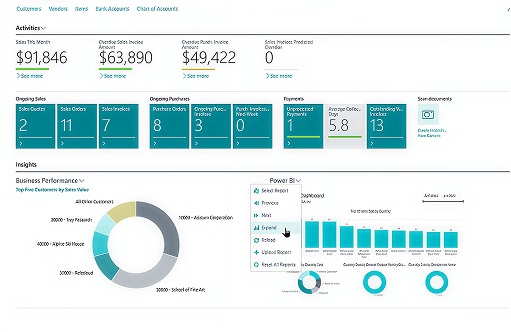
End-to-end business process automation covers all key areas of company operations. Modules are configured to match each business’s unique needs, exchange data without delays, and enable teams to work within a unified cloud ecosystem.

Cash flow accounting, cost calculation, automated online banking (bank-client) integration, and IFRS reporting.

Sales pipeline management, lead tracking, automated generation of commercial proposals, and shipment control.

Supplier reliability monitoring, automated order volume calculation, and tracking of invoices in transit.

WMS-based location management, product barcoding, cross-docking, and optimization of picking routes.

Bill of Materials (BOM) management, production line capacity planning, defect control, and material consumption accounting.
Time tracking, calculation of complex KPI-based bonuses, leave management, and management of the company’s talent pool.
Electronic contract approvals through Workflow routes, standardized document templates, and fast search within a cloud archive.
Creation of clear visual charts and predictive business models in Power BI, based on big data.

Automate payroll calculations, taxes, and employee payments without manual processing.
Process: Two to three meetings with the client, during which we interview stakeholders and identify the main business problems. Based on the expert assessment, we prepare a list of the required work and present it to the client.
Primary Purpose: A general view of the project’s scale, needed for the first decision: which system to choose and whether to proceed.
Outcome: A preliminary estimate of scope, timeline, and budget. The figures are approximate: actual numbers may differ.
Duration and Cost: From one day to two weeks. No charge.
Process:
Primary Purpose: A clear understanding of the project’s real scope before it starts.
Outcome: Estimate accuracy with a margin of error of up to 10% and controlled cost. The client receives an agreed model of the future system, a technical specification, a project estimate, an implementation schedule, and a roadmap.
Duration and Cost: A separate phase that precedes the project. Cost ranges from 5% to 30% of the budget, depending on the project’s uniqueness: the closer it is to standard functionality, the lower the cost.
ERP implementation is, first and foremost, the automation of a company’s business processes, and most challenges in such projects arise not from the system itself, but from the implementation approach. Our methodology is the result of 25 years of experience and more than 200 completed projects.

We conduct a series of interviews with users across all areas that require automation and document the processes and requirements in formal records. We model the processes within the standard system configuration and validate with the client that they are reflected correctly. Based on the Fit-Gap analysis, we identify differences between business needs and standard functionality, prepare the technical specification, and assess the feasibility of each customization.

Based on the Discovery phase, the CBPM Service team presents the client with a model of the future system, the technical specification, project estimate, and implementation approach. We approve the project schedule and roadmap jointly with the client and project team before work begins.

CBPM Service analysts prepare a list of migration objects, define the format and sequence of data transfer, and agree on these with the client.
We carry out implementation using a sprint-based approach, which gives us clear control and transparent status at every stage. Our team performs all customizations strictly per the approved technical specification and demonstrates the finished functionality to the client.

We provide initial training for the client’s team so that users can work in the system and test it using their own business processes.

We process master data and product catalogs separately from balances, including inventory, cash-related liabilities, settlements with customers and suppliers, and payroll. Before migration, we perform data mapping and clean outdated information. CBPM’s experts export data using dedicated scripts as of a specified date and transfer the agreed scope to the test database.

During the test operation phase, the client works in the new system. Based on the results, we either proceed to production launch or prepare a list of required refinements.

We implement the agreed refinements and confirm readiness for production operation. We then switch operations to the new system. CBPM Service consultants work alongside the client’s employees during the first reporting period close, identify any issues, and promptly resolve deviations. Our experts then provide ongoing support and maintenance in accordance with the SLA.
Business process automation enables companies to replace manual operations with automated workflows and a unified digital management system. It helps integrate finance, warehousing, sales, and other departments into a single operational environment, reduce errors, eliminate data duplication, and accelerate company operations.
If closing the balance takes weeks, warehouse inventory records constantly differ from actual stock levels, and managers lose orders because of chaos in spreadsheets, the company urgently needs modernization. An ERP system eliminates these problems by creating a single, reliable source of information.
In a small company, automation removes the dependence of processes on the owner’s personal involvement: invoices, recurring payments, and standard documents are generated from templates, and an approval matrix by amount and expense item makes it possible to delegate payments without checking each one manually. The system runs in the cloud with per-user pricing, so the company needs neither its own servers nor a full-time system administrator. For medium-sized businesses, the main advantage is a single environment: a sales order reserves stock in the warehouse and generates an invoice without re-entering data, and finance, inventory, and sales work with the same data. When the company opens a new warehouse, branch, or legal entity, we transfer the configured process logic to the new unit without building the system from scratch. We launch automation in phases, starting with the areas where manual work slows the business down the most.
Partial business process automation, where each department uses separate specialized software, creates isolated systems and fragmented data. This leads to manual data transfers, duplicated operations, errors, and delays. Only a comprehensive ERP platform can provide a unified information environment and seamless interaction between all of the company’s business processes.
The duration of automation depends on the complexity of the processes, the number of integrations, and the size of the company. Basic automation scenarios can be implemented within a few weeks, while complex projects are delivered in stages over several months. An Agile approach allows individual processes to be launched gradually without waiting for the entire project to be completed.
Corporate information is hosted in certified Microsoft Azure data centers located within the European Union. Data is encrypted according to banking-grade security standards, while database backups are performed automatically every hour, helping protect information against loss, damage, and unauthorized access.
Leave your contact details and briefly describe your situation, including your current system, number of users, and the issues you would like to resolve.
A 30-minute conversation to discuss your pain points, timeline expectations, and the project delivery approach so we can select the right team for your needs.
Technical audit of the IT architecture, project scope and boundaries, system concept, and preliminary roadmap.
A specific document outlining the scope of work, timelines by stage, and cost.