
Procurement and manufacturing ran in BAF, retail sales in Magento and Magestore, while financial accounting, payments, and VAT reporting were handled in Excel. None of the systems were automatically connected to any other, so any operation spanning more than one system required manual data transfer and reconciliation.
ERP implementation • Spanish localization • Jewelry industry
Implementation of the sales subsystem in Microsoft Dynamics 365 Business Central with Spanish localization
Before the project began, key sales, inventory management, and financial reporting processes were distributed across four different systems and Excel spreadsheets, making it impossible to effectively manage them within a single environment. The CBPM Service team implemented the first stage of the sales subsystem in Microsoft Dynamics 365 Business Central, taking into account Spanish localization, the specific requirements of the jewelry industry, and integration with the client’s existing systems.

📑 2 days → 40 minutes
Preparation of initial store replenishment documents
📉 −30%
Effort required to generate invoices
🕐 −25%
Time required for inventory counts
Infrastructure that was limiting growth
Carrera Y Carrera manufactures and sells its own jewelry products through B2B and B2C channels across several countries. Before the project, accounting and operational processes were distributed across four tools: BAF, Magento, Magestore, Sage, and Excel. Every operation involving more than one system required manual data transfer and reconciliation. Jewelry-specific requirements such as serial numbers, weights, gemstones, and warranties were not supported by any system in a structured format.
Each item has a serial number, material, fineness, color, size, gemstone type and weight, net gold weight, photo, and warranty information. None of the existing systems supported this level of detail in a structured format. These attributes were maintained manually in Excel, creating a constant risk of errors and discrepancies.
Financial and tax accounting was maintained in Excel, making it impossible to generate reliable VAT reporting in real time. Bank payments were imported manually, slowing down processing and increasing the risk of discrepancies between actual transactions and accounting records.
None of the existing tools were designed to simultaneously support B2B and B2C channels, serial and weight-based jewelry tracking, integration with the manufacturing system, and Spanish regulatory requirements. Attempts to implement the required processes on platforms below the ERP level did not deliver the necessary results.
Spanish legislation requires the transition to electronic invoicing. Without a unified ERP platform with Spanish localization, preparing for this transition in day-to-day operations was not feasible. Excel could provide neither the required document structure nor the necessary reporting.
The problem affected the entire operational chain: product master data, finished goods inventory, serial and weight-based tracking, B2B customers, e-commerce orders, bank payments, printed forms, and document numbering. Each element existed in a separate system with no automated connection to the others.
Objectives and critical requirements
The client requested the implementation of the first stage of the B2B and B2C sales subsystem in Business Central with Spanish localization within a tight four-month timeframe. In addition to launching the core sales functionality, the system had to integrate with BAF for two-way exchange of master data and finished goods, support jewelry-specific accounting requirements, and establish the technical foundation for future electronic invoicing as soon as the relevant functionality becomes available in the Spanish localization.
1. A unified system for B2B and B2C sales

Support for both sales channels without process gaps, duplicated operations, or manual updates of finished goods data after production.
2. Stable integration between BAF and Business Central

Migration of a large volume of data while preserving relationships between objects, as well as synchronization of products, inventory balances, and customer data without loss or duplication, both during the initial data load and subsequent regular updates.
3. Support for jewelry industry-specific requirements

The system had to support unique product characteristics and business logic that go beyond the standard functionality of Business Central.
4. Complete product traceability and control

Accurate traceability of every jewelry item was critical, with no errors in serial numbers or weight parameters at any stage of product handling.
5. Standardized document workflow

The system had to provide a unified approach to generating sales documents, including standardized print forms and rules that eliminate manual deviations from established business processes.
6. Compliance with Spanish local requirements

The solution takes into account the specific requirements of the Spanish market and applicable regulations. A separate priority was readiness for electronic invoicing without requiring major future customizations.
7. Transparent data exchange and error control
The client required a complete audit trail for every integration record, including its creation, update, or rejection status together with the reason, ensuring full control over the data exchange process.
What the CBPM Service team did and how
Implementation
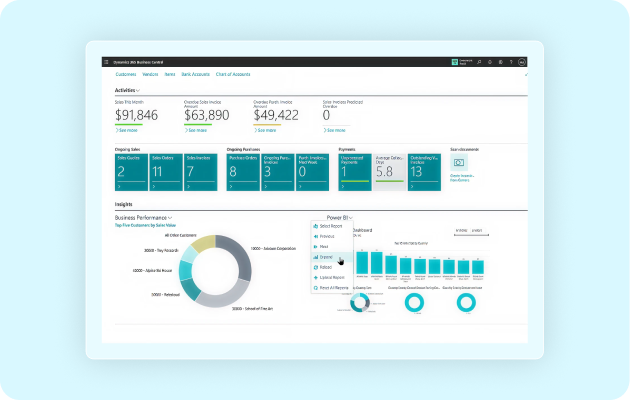
The solution was built around Business Central as the single target system for sales and inventory management. The architecture combines master data migration, API-based exchange with the manufacturing system, industry-specific customization, and data integrity controls in a way that minimizes reliance on manual operations and reduces the risk of integration errors.

Architectural solution
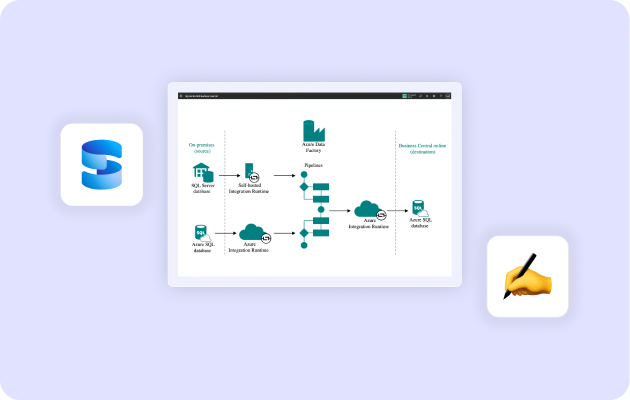
The team separated one-time migration from regular operational data exchange. Master data and opening balances were loaded from BAF through Excel and configuration packages in stages, with validation before finalization. Ongoing receipts of finished goods and B2C sales from Magento/Magestore are transferred through APIs as part of regular updates.
The API creates item journal lines with the full set of required attributes. If an item or master data record is missing in Business Central, an extended JSON payload from BAF allows the required records to be created directly during the data exchange. Every exchange is logged with its status and reason for rejection, ensuring transparency and enabling rapid identification of issues.
Adaptation to jewelry industry requirements
Standard Business Central functionality is not designed to store industry-specific jewelry attributes. To address these requirements, we developed extensions including additional master data and item fields for material, fineness, color, size, gemstone type and weight, and collection; a separate serial number data table; weight and net weight fields in sales document lines, posted documents, returns, credit notes, and item tracking; as well as automatic weight totals for consolidated reporting.
The custom fields are carried through the entire process, from the item card to the final sales document and product movement tracking. As a result, every jewelry item can be identified and traced throughout its lifecycle, from receipt from production to shipment to the end customer or sale through a consignment channel.

Consignment accounting
A separate consignment process was implemented, covering the transfer of goods to a consignment warehouse without transfer of ownership, recording sales to end customers through the consignment channel, and automatic creation of an internal sale once the item is sold. This allowed the consignment model to be incorporated into the unified Business Central environment without additional manual postings.
What was implemented

A complete set of sales documents was configured in the system: Proforma Invoice, Order, Sales Invoice, and a price list with product images.

A custom numbering algorithm was implemented for sales documents using the document prefix, C/, the last two digits of the current year, and a sequential number, in accordance with the client’s requirements.
Bank payment imports from the client’s banking systems were configured, along with P&L parameters and analytical dimensions.

Spanish localization was deployed with VAT support in accordance with Spanish requirements. The system is structurally prepared for future electronic invoicing within the same localization without the need for major redevelopment.
Data and master data management
- First, the structure of master data and custom fields was defined in Business Central, after which the data was loaded on a one-time basis using Excel and configuration packages.
- Responsibilities were clearly divided between the parties: the client’s team handled the export of master data, product catalogs, inventory balances, and post-production data from BAF, while the CBPM Service team implemented data intake in Business Central, item journal creation, error logging, and generation of the required documents.

Working with the client’s team
One of the key factors that made it possible to complete the project within four months was the client’s appointment of a responsible project manager with decision-making authority, while the company’s top executive participated as project sponsor in monthly coordination meetings. This enabled fast communication, timely alignment on key issues, and continuous control over task execution without delays or the need for escalation.

Custom technical solutions

Product weight and net weight are transferred not only to the item card, but also to sales document lines, posted documents, returns, credit notes, and item tracking, ensuring complete data at every stage of the transaction.

Data exchange logging with the status of each record (created, updated, or rejected with a specified reason) turns the integration into a controlled, auditable process rather than a black box.
For scenarios where an item or related master data record is missing in Business Central when data is received from BAF, we implemented automatic creation of the required records based on an extended JSON payload. This prevents the process from being blocked due to incomplete data.
A custom sales document numbering algorithm makes it possible to maintain the client’s internal standards and preserve them as the number of transactions scales.
Results
Metric
Invoice generation
Preparation of store replenishment documents
Inventory counts
Before
Baseline effort
2 days
Baseline duration
After
−30% time
40 minutes
−25% time
Lower risk of manual errors in product data, serial numbers, weights, inventory balances, and documents.
Improved traceability of integration errors through data exchange logs.
Greater readiness for VAT regulatory requirements and electronic invoicing.