
Our methodology

How we build ERP projects: an approach that eliminates uncertainty

Nearly 60% of the companies we start working with describe the same experience: timelines keep extending, the budget increases after every meeting, and the implemented system remains underused. Over 25 years, we have studied the causes behind these problems and developed a methodology that eliminates them before the project even begins.

Official Microsoft Partner

25 Years

of ERP Automation Experience

200+

Completed Projects Across 12 Industries

Hybrid Expertise

BAS and Microsoft Dynamics 365 Business Central

According to industry data, 60% of ERP implementations are technically completed but fail to deliver value to the business

The problem is rarely the system itself. The problem is the project approach.

Request a Technical Audit

When an ERP project is delivered in one large cycle instead of Agile sprints with intermediate results, the team and the client receive the first real feedback only at the launch stage.

Consequence

For months, there is no intermediate result that can be reviewed. If something does not meet expectations, correcting it at the final stage becomes time-consuming and expensive.

The project begins without a clearly defined list of functions and implementation boundaries. Every meeting adds a new requirement that is neither formally assessed nor re-approved.

Consequence

The budget increases after every meeting, while the deadline gets lost in the expanding scope of work.

The team configures a standard solution without going deeply into how the client’s actual processes work. The system goes live from a technical standpoint, but it does not match the established way of working.

Consequence

The system works, but the team goes back to Excel and old ways of working.

The solution to these challenges: the CBPM methodology developed over 25+ years of experience

Over the years of working with 4+ ERP systems, we have developed an approach that provides control over scope, budget, and timelines at every stage. Here is what the CBPM team’s methodology is built on:

We deliver projects using Agile sprints

The sprint-based model provides measurable results at every stage, keeps the project manageable, and ensures that the client is regularly informed about progress. Implementation and migration are carried out without interrupting day-to-day business operations.

We ensure the right balance between standard and custom functionality

We design processes around the BC core with a clear architecture tailored to your business needs and minimal customization.

We conduct an in-depth audit of business processes before the project begins

Fit-Gap analysis and development of the target model based on your processes enable project estimates with a deviation of no more than 10% and provide predictable costs before implementation begins.

We have hybrid expertise across 4+ ERP platforms

25+ years of ERP implementation experience across different platforms, with deep practical expertise in BAS, 1C, Microsoft Dynamics 365 Business Central, and Odoo.

We provide team training and post-launch support

We support the client’s team during the initial launch period, including the first month-end close, and continue developing the system as the business grows.

Before the project begins, we conduct an in-depth Discovery assessment

This is the stage where the project scope, timeline, and budget are defined. The deeper the assessment, the more accurately these parameters reflect reality, making the budget and risks easier to control.

Process

Time management hourglass icon

◻ A series of interviews with users across all areas subject to automation, with formal meeting documentation;
◻ Development and demonstration of the target model using the client’s real-life examples, mapping actual business processes to standard functionality and future subsystems;

Receipt document icon

◻ Fit-Gap analysis to identify areas where standard functionality does not meet business requirements;
◻ Technical specifications for each required customization;
◻ Final project estimate.

Main purpose

Business finance and payments icon

To understand the actual project scope before implementation begins.

Result

Risk and disruption icon

High estimation accuracy, with a deviation of up to 10%, and predictable project costs.
◻ Confirmed model of the future system
◻ Technical specification
◻ Project estimate
◻ Project schedule
◻ Roadmap

Duration and cost

Business documents icon

A separate stage completed before the project begins. The cost ranges from 5% to 30% of the project budget, depending on the project’s level of customization: the closer the requirements are to standard functionality, the lower the assessment cost.

A full Discovery phase is not always required for the initial decision: we offer a faster format

Rapid Assessment

Process: Conducted through two to three meetings with the client, during which we interview stakeholders and identify the key business pain points. Based on our expert assessment, we prepare a list of the required work and present it to the client.

Primary Purpose: Provides a high-level understanding of the project scope needed for the initial decision: which platform to choose and whether to proceed.

Outcome: We provide a preliminary estimate of the project scope, timeline, and budget. At this stage, the figures are indicative, and the actual costs and timelines may differ significantly from the initial forecast.

Duration and Cost: Takes from one day to two weeks and is provided free of charge.

Request an Assessment
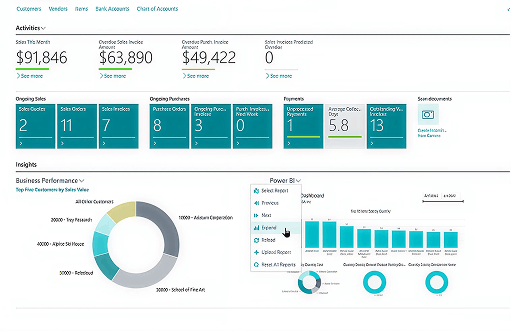
Business analytics and financial dashboard

Methodology and implementation process

Most ERP project challenges arise not from the system itself, but from the implementation approach. We have refined our methodology over 25 years and more than 200 projects. Here is how it works.

1. Pre-project assessment

Search and data analysis icon

We conduct a series of interviews with users across all areas subject to automation and document the processes and requirements in formal records. We model the processes using the standard system configuration and validate their accuracy together with the client. Based on the Fit-Gap analysis, we identify discrepancies between business needs and standard functionality, prepare the technical specification, and assess the feasibility of each customization.

2. Project schedule and roadmap

Office printer icon

Based on the results of the Discovery phase, CBPM Service specialists present the client with the model of the future system, the technical specification, project estimate, and implementation approach. We agree on the project schedule and roadmap with the client and project team before implementation begins.

3. Migration scope alignment

Digital transformation magic wand icon

CBPM Service analysts define the list of objects to be migrated, the format and sequence of the migration, and agree on these with the client.

4. Configuration and development

Business analytics bar chart icon

We implement the solution using a sprint-based methodology, with coordination meetings every two weeks and a mandatory monthly meeting with the project sponsor. This ensures controllability and transparent project status at every stage. We carry out all customizations in accordance with the approved technical specification and demonstrate the completed functionality to the client.

5. Initial training

Training and education icon

We provide initial training for the client’s team so that users can work in the system while testing it against their own business processes.

6. Migration to the test database

Computer workstation icon

We process master data and product catalogs separately from balances, including inventory, cash-related liabilities, settlements with customers and suppliers, and payroll. Before migration, we perform account mapping and remove outdated data. We carry out the export using dedicated scripts as of a specific date and transfer the agreed data scope to the test database.

7. Test operation and refinement

Business partnership handshake icon

The client works in the new system in test mode. Based on the results, we either proceed directly to production operation or document a list of required refinements.

8. Production launch and support

Air travel and transportation icon

We implement the agreed refinements and confirm readiness for production operation. We then switch the operational environment to the new system. CBPM Service consultants work alongside the client’s employees during the first reporting period close, identify any issues, and promptly resolve deviations. Our specialists then provide ongoing support and maintenance in accordance with the SLA.

What determines the success of an ERP project: mutual responsibility for the outcome

Successful projects have several common conditions on the client’s side, and we discuss them before the project begins to ensure delivery within the agreed budget and timeline. Each point reflects a specific lesson learned from previous projects and has helped protect client budgets.

Responsible persons and roles

The client appoints its own project team, including a key user and a project sponsor. Participant roles must be clearly defined: who is responsible for the budget, who makes decisions about expanding the scope, and who is responsible for completing specific tasks.

Coordination meetings

Regular coordination meetings keep both parties aligned on the project status, budget, and individual workstreams. We hold status meetings every two weeks, while a monthly meeting involving the project sponsor is used to align on the overall status and development priorities.

Project management

The project methodology requires dedicated time and budget for management activities, including planning, execution control, and meeting documentation. This ensures continuous task monitoring and adherence to deadlines. We support the technical side through structured procedures, including documentation of configuration changes and release management.

A sprint-based approach combined with adherence to these conditions is the key to a successfully delivered project

Client-side resource allocation

We prepare and agree on a resource allocation plan for the client’s specialists and require adherence to it. The plan specifies which specialist must be allocated and for how much of their working time, for example, 50%, during a particular month. This prevents project team downtime and helps maintain the agreed schedule.

Client team motivation

The client approves an internal document defining incentives for its project team and shares it with us: what each participant receives if the implementation is successful and what they may lose if it is unsuccessful. Projects are delivered noticeably more effectively when the client’s internal team clearly understands how its motivation is tied to the outcome.

Deadline discipline

If the agreed schedule is disrupted due to the client, any additional hours worked beyond the approved budget are charged separately, while work performed outside the agreed plan is billed at a 30% higher rate. The purpose is not to generate additional revenue, but to keep the project within the agreed budget, scope, and timeline.

Downtime compensation

If the implementation team experiences downtime due to the client, this downtime is compensated according to the agreed calculation. The team is allocated specifically to the project, and its time is reserved in advance.

Mutual guarantees from the implementation partner

When the client accepts these commitments, we guarantee compliance with the agreed deadlines on our side. Otherwise, equivalent penalties apply to us. This is symmetrical responsibility, not a one-sided requirement.

How project cost is calculated and why deviations are minimal

We calculate the project cost based on the Fit-Gap analysis, with a deviation of up to 10%. This keeps the budget manageable and predictable after the project begins.

What is included in the project cost

◻ All work defined during the pre-sales analysis and Discovery phase
◻ Client team training
◻ Support during the post-launch stabilization period

What is calculated separately

◻ New requirements introduced after the project scope has been approved
◻ Expansion of the project to additional departments or legal entities beyond the initial scope
◻ Licenses or license selection

Looking for an alternative to 1C or BAS?

Demand for migration from 1C to international platforms continues to grow, and Business Central is one of the most popular migration options.

Book a 30-Minute Consultation
  • Data and business logic preservation

  • Parallel operation of both systems during migration

  • Team training included

Tell Us About Your Project

    We respond within
    24 hours on business days

    1. Inquiry

    Leave your contact details and briefly describe your situation, including your current system, number of users, and the issues you would like to resolve.

    2. Introductory Call with a Manager

    A 30-minute conversation to discuss your pain points, timeline expectations, and the project delivery approach so we can select the right team for your needs.

    3. Pre-Project Discovery

    A technical audit of your IT architecture, definition of the project scope and boundaries, development of the system concept, and preparation of a preliminary roadmap.

    4. Proposal

    A detailed document outlining the scope of work, timeline for each project stage, and estimated cost.