Without barcoding, every movement of a fabric piece or bundle of cut parts between production areas — from weaving to dyeing, from cutting to embroidery, and from embroidery to sewing — had to be recorded manually. This took time and left room for errors.
Light industry • Textile and apparel manufacturing
End-to-end traceability from yarn batch to finished garment: production accounting for Edelvika
Edelvika covers the full production cycle, from fabric manufacturing to finished garment production. This meant that two fundamentally different manufacturing processes had to coexist within a single accounting system: continuous weaving and discrete cutting and sewing. Our team implemented production accounting based on a unified ERP system, where every fabric cut and every bundle of cut pieces is assigned its own barcode, which changes at each subsequent stage — from raw material production to the calculation of piece-rate wages for a specific employee.

🏷️ Full traceability
weaving, cutting, and garment production without an additional tracking system
🧵 Two production types unified
through end-to-end document flow
💶 Piece-rate wages
calculated automatically based on completed operations
Customer situation before the project
PrJSC Edelvika is a Ukrainian apparel manufacturer operating under the Edelvika brand. Since 1994, the company has combined its own weaving production and garment manufacturing within a single production cycle at a 6,400 m² facility in Lutsk, employing around 250 people. Weaving and garment production operate according to different logic: the first is a continuous process that transforms yarn into finished fabric, while the second is a discrete process involving cutting, bundle formation, embroidery, and sewing. Bringing both into a single accounting environment required building end-to-end logic that would work consistently across both production areas.
When the raw material batch used to produce a piece of fabric is not linked to that specific piece in the system, identifying the cause of a defect — whether defective yarn or a deviation from the dyeing process — becomes a matter of guesswork rather than data verification.
Materials, equipment, and personnel in the weaving and garment production areas are resources with different planning logic. Without unified ERP coordination, they were managed as if they were two separate businesses operating under the same roof.
Manual recording of completed operations, quality control, and raw material accounting meant that data quality depended on the attention of a specific employee at a specific stage rather than on system logic.
A single production cycle covers warp preparation, weaving, and dyeing for fabric, followed by cutting, embroidery, and sewing for garment production. Each production area had to become part of a single document flow rather than operate as a separate accounting system.
Objectives and critical requirements
The request involved building production accounting that would cover the full cycle — from raw materials to finished goods — while minimizing dependence on manual data entry and human error at every stage.
1. Minimize time spent entering information

Record production operations by scanning barcodes instead of manually completing documents at each production area.
2. Trace raw material batches and finished goods

Make it possible to trace which batch of yarn was used to produce a specific piece of fabric and identify the production stage where a deviation occurred at any time.
3. Reduce the impact of human error

Automate the recording of completed operations and quality control results through scanning instead of handwritten records or verbal agreements.
4. Coordinate production resource management within ERP

Combine accounting for materials, equipment, and personnel across two different production processes — weaving and garment manufacturing — within a single system.
5. Correct cost calculation across two production stages

Enable separate cost calculation for the cutting and sewing stages rather than calculating cost only for the finished product as a whole.
6. Accurate piece-rate wage calculation

Calculate wages based on the actual completed and scanned operations rather than estimated time sheets.
What our team did and how
Master data and standards: when one product means several production stages
The first step in building the accounting system was to rethink what an “item” actually means in fabric production.
The same product passes through several technologically independent states: warp, greige fabric, and finished fabric after dyeing. Each of these states was assigned its own item in the master data and its own routing with a list of operations, materials, and consumption standards — instead of describing the entire fabric production process in a single generalized document.
This decision became fundamental to all subsequent accounting: by separating the process into stages, it became possible to accurately standardize labor and material consumption separately for warping, weaving, and dyeing rather than allocating overall costs conventionally.

Documenting weaving processes by production area
The fabric production cycle was divided into three production areas, each with its own set of documents:
◻ the warping area works with the “Warp Order” and “Warp Output” documents;
◻ the weaving area uses “Warp Installation on Loom,” “Warp Removal from Loom,” “Fabric Piece Output,” and “Fabric Piece Quality Control”;
◻ the dyeing area uses “Fabric Piece Transfer,” “Finishing Act,” and “Fabric Piece Cutting.”

Each document records a specific production operation at the moment it is performed rather than after the fact.
This separation later made it possible to build reporting for each production area individually, including quality grading reports, warp reports, and analysis of rejected fabric balances, instead of relying on one generalized report for the entire weaving operation.
Barcoding and raw material batch traceability

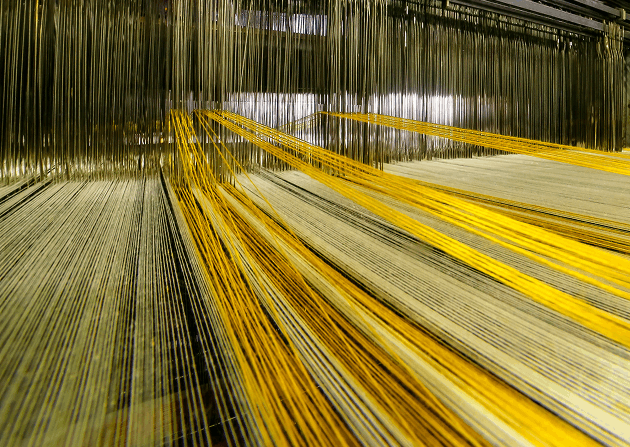
We implemented a system in which every piece of fabric receives a unique barcode at the time of production and a new barcode at each subsequent stage: after quality control and after finishing.

This makes it possible to determine exactly which processing stage a specific piece of fabric is at at any given time.

At the same time, we linked each piece to the supplier’s raw material batch — yarn or dye chemicals. This solved the problem of identifying the cause of defects: now a defect can be traced back to a specific raw material batch instead of requiring all data sources to be checked manually.

To record operations directly on the production floor, we connected scanners and data collection terminals to the unified environment, eliminating the need to return to a computer after every action.
Cutting and dual routing for embroidery
We implemented a “Cutting Act” document supporting two scenarios — cutting with spreading and cutting without spreading. At the same time, the system automatically generates barcode labels for each bundle of cut parts.
We also addressed a separate scenario for embroidered garments: the system generates two labels simultaneously — one for the embroidery area and one for the sewing area — while sewing cannot begin until both sets of components have arrived at the sewing area. This eliminated a common error: starting garment assembly before the embroidery was completed or available.
The movement of each bundle from cutting to sewing is fully traceable through barcode scanning, while the “Bundle Passport” document shows which stages have already been completed and where the bundle components are physically located.
Flow-line sewing and piece-rate labor accounting
We configured two sewing modes — individual and flow-line production — with operations divided into stages depending on the number of employees involved, and connected labor accounting to the same barcode-based process.
At each stage, the system records the employee performing the operation, while the quality controller is also recorded at the final stage.
Data on completed operations is transferred to the “Work Completion Report” document, which combines barcode-based piece-rate accounting with hourly accounting where operation-based standardization is not possible. These records, rather than retrospective time estimates, became the basis for calculating piece-rate wages and reporting on individual employee productivity.

Cost reporting across two production stages
We implemented planned cost calculation based on actual completed operations and consumed materials, broken down by cost category and separately by production stage: cutting and sewing.
This separation reflects the different cost structures of the two processes: cutting costs are primarily material-based, while sewing costs are primarily labor-based.
The calculation was also supplemented with a profitability coefficient for determining selling prices, so the costing document immediately answers both questions: how much the product cost to manufacture and at what price it should be sold.

Results
Textile production

Multi-stage item structures and routings created a standardized basis for cost calculation and planning, replacing the conventional allocation of costs across the entire fabric production process.
Weaving production

Each fabric piece can be traced from the raw material batch to the finished fabric through a sequence of barcodes, making it possible to identify the cause of defects using specific data rather than assumptions.
Garment manufacturing

Customer orders can be tracked end to end, from receipt to shipment, with intermediate statuses such as “cut,” “embroidered,” and “sewn,” without having to collect this information manually from different sources.
Cost calculation

Planned costing shows production costs separately for the cutting and sewing stages, providing a more accurate basis for pricing than an averaged cost of the finished product.
Cutting and routing
The movement of each bundle through cutting, embroidery, and sewing is recorded exclusively by scanning, while the “Bundle Passport” provides an immediate answer to where the bundle is now and which operations have already been completed.
Payroll

Piece-rate wages are calculated automatically based on actually scanned operations, with separate reports showing the productivity of each employee.