
Before the project, all management accounting by potential deal was maintained in consolidated Excel spreadsheets. Statutory accounting was handled separately within each country’s local accounting environment, including 1C.
Management accounting • Potential deals • Software distribution
Configuration of potential deal tracking and license validity periods in the Business Central management database
IITD sells software through a partner model: procurement from the vendor, deployment for the end customer, testing, and payment collection are handled through the partner, while a significant part of the process is managed in CRM. The CBPM Service team extended the management accounting database so that the potential deal became the central point for tracking sales, purchases, license validity periods, and product movement.

📑 The potential deal became a single center
For tracking sales, purchases, products, and licenses
📉 Management accounting moved beyond Excel
Deal data is now maintained in one structured system
🕐 License validity periods under control
Recorded in purchase documents and print forms
Situation before the project
Manual data management across multiple sources created a risk of duplicate information and made it difficult to track margins, purchases, and sales for a specific deal. There was no single place to monitor subscription and license validity periods.
Building the management database as the group’s central accounting environment required sales and purchase documents to be transferred to local accounting databases with the correct deal context rather than being processed separately from the deal itself.
The process involved several companies and local databases across different countries, CRM as the primary system used by managers, multiple types of sales and purchase documents, and multi-level product movement routes.
Objectives and critical requirements
IITD’s request involved extending the functionality of the management database so that a potential deal would become a full-fledged accounting object rather than just a reference marker.
1. Tracking potential deals in purchases and sales

Link every purchase and sales transaction to a specific deal without breaking the data connection between documents.
2. License validity period control

Track license validity periods in purchase documents, with mandatory completion for selected product categories.
3. Potential deal products and routes

Create products within a potential deal and track each product’s route through the deal from purchase to sale.
4. Readiness for future exchanges with local databases

Build a structure that will later allow documents to be transferred to local accounting databases with the complete deal context already included.
5. Identified cost accounting

Ensure identified cost tracking for product purchases and sales within each deal.
Technical constraints

The solution had to operate within Business Central, relying on standard documents wherever possible and extending them with custom fields and tables only where standard functionality was insufficient.
Organizational constraints

The process could not disrupt the work of managers in CRM or accountants in local databases, so part of the exchanges with accounting databases was moved into a separate detailed technical specification.
What the CBPM Service team did and how
Potential deal card as the central data hub
The team added a CRM-integrated block to the potential deal card, along with a separate section for viewing product movement within the deal.
A Potential Deal field was added to purchase and sales documents, linking all related transactions within a single environment.
When documents are posted, the system automatically accumulates data in a separate table on purchases, sales, products, quantities, prices, vendors, and license validity periods, ensuring that all deal-related information is stored in a single source.

License validity periods and identified cost accounting
A field for license validity periods was added to purchase documents, and for selected product categories, completing this field became mandatory. For products associated with a deal, automatic lot generation was implemented in purchases and lot selection in sales, ensuring identified cost accounting for both purchasing and sales transactions.
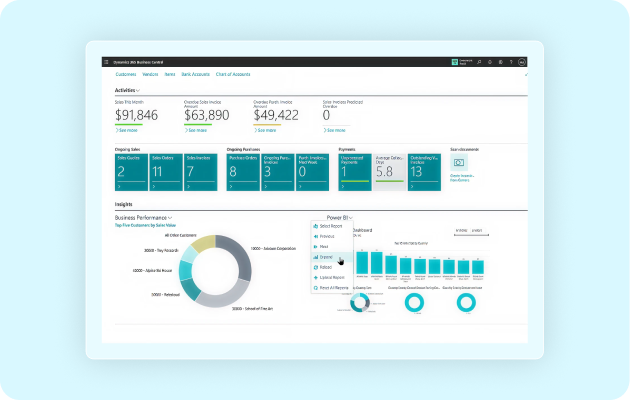
Document workflow tailored to the client’s requirements
Document print forms were customized to the client’s requirements, including the display of information on licenses, subscriptions, and the end customer.

Complex aspects and non-standard solutions

Standard Business Central functionality did not fully cover IITD’s management accounting scenario: a potential deal had to combine CRM logic, sales, purchases, product routes, cost accounting, and license validity periods, while in the standard process this data is distributed across different documents or is not available in the required context at all.

The non-standard solution was to use the potential deal as the central object of management accounting. Around it, the team built a mechanism for accumulating data on products, purchases, sales, vendors, end customers, and license periods.
As a result, the client receives a single source of information for each deal instead of a set of disconnected documents.
Working with the client’s team
One of the key factors in the successful delivery of the project was the client’s appointment of a responsible project manager with decision-making authority, while a top executive joined as project sponsor and participated in monthly coordination meetings.
This made it possible to maintain efficient communication, resolve issues in a timely manner, and control task execution without delays or the need for escalation.

Implementation methodology
The implementation followed the CBPM Service sprint-based methodology: we gathered the client team’s requirements for the potential deal card, aligned on the high-level concept, and documented the details in the technical specification.
After development and testing, the functionality was demonstrated to the client. The team provided clarifications regarding print forms and license validity periods, after which we refined the solution and, following the demonstration of the final version, launched it into production operation.
Support and consulting continue as part of the ongoing working process.

Results
As a result, the Business Central management database became the central environment for maintaining information on potential deals.
Instead of fragmented accounting in Excel and separate systems, IITD received a structured process in which purchases, sales, products, license periods, and product routes are linked to a specific deal.

Qualitative results:

The potential deal became the single center for accumulating management information on sales, purchases, products, vendors, end customers, and licenses.

Dependence on manual management accounting in Excel was reduced.

It became possible to analyze each deal not only from the sales perspective, but also in terms of procurement, cost, vendor, and margin.

Managers continue working in CRM, while the management database accumulates complete deal information, ready to be transferred to local databases.
License and subscription validity periods are controlled in purchase documents and print forms.
What the client can do now that was not possible before the project:
View complete information about a potential deal in one place

Link purchase and sales documents to a specific deal

Accumulate data on deal products, prices, quantities, vendors, and end customers

Record and monitor license validity periods
Generate documents and print forms that include license periods and end-customer information